
aw - Airfoil vieWer
Yet another airfoil viewer
Yet another airfoil viewer
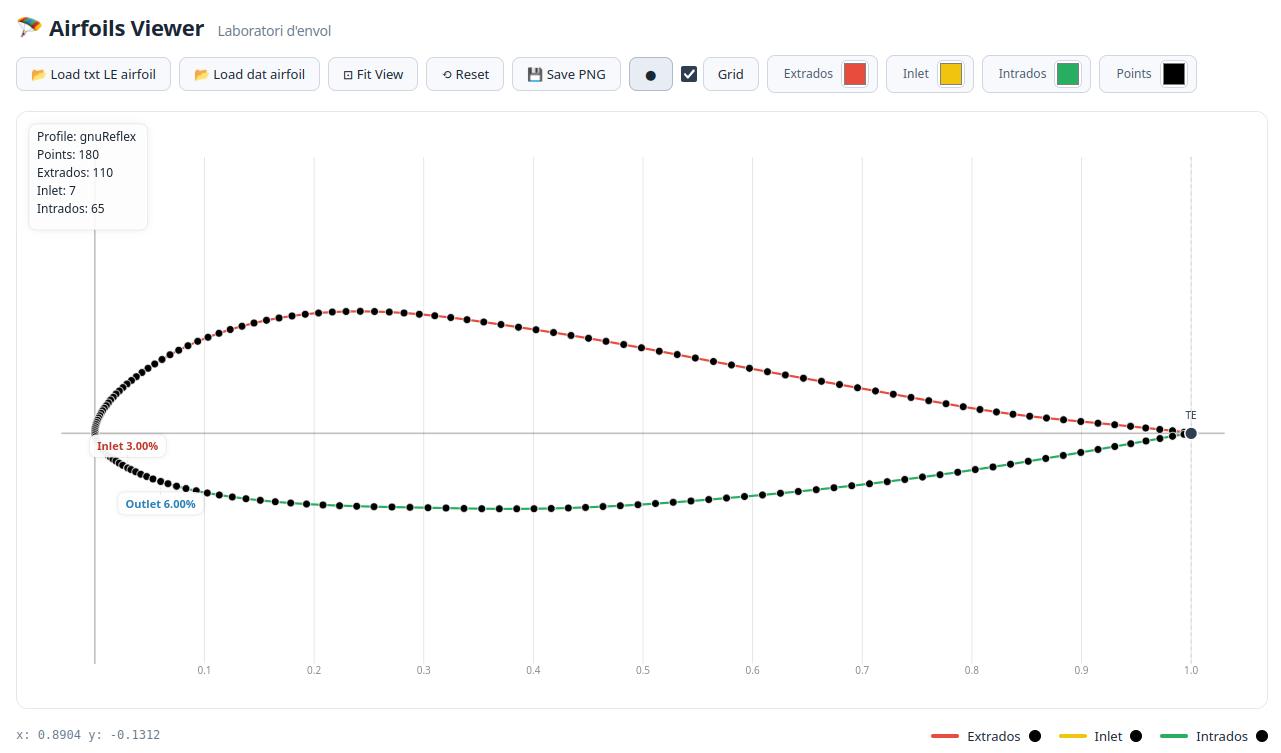
Laboratori d'envol aerodynamic profiles are written in a text file (txt extension) and have the following format:
Line 1: character ; contains a text string with the name of the profile
Line 2: integer ; is the total number of points in the profile
Line 3: integer ; is the number of points in the upper part of the profile, known as "extrados". The extrados starts at the trailing edge and ends at the inlet inlet.
Line 4: integer ; is the number of points in the air inlet part, known as "inlet". The inlet starts at the same point where the extrados ends and ends at a point that we will call "outlet"
Line 5: integer ; is the number of points in the lower part of the profile, known as "introdos". The intrados begins at the outlet point and ends at the trailing edge.
Lines 6 and following: real real ; are the coordinates (x,y) of the points that defines the contour of the aerodynamic profile. The order of the points is starting at the trailing edge (1,0), continuing along the upper part of the profile (extrados), until the point called inlet, continues through the outlet point (between inlet and outlet points it is considered that the air inlet is defined), and continues along the lower part of the profile (intrados) until the trailing edge (1,0).
Usually we consider unit profiles, of chord 1 unit, with the trailing edge at the point (1.0,0) and the point called "nose" (or leading edge) at the point (0.0,0.0) where the coordinate axes (X,Y) have their origin.
Aerodynamic profiles in dat format are written in a text file (but using dat extension) and have the following format:
Line 1: character ; contains a text string with the name of the profile
Lines 2 and following: real real ; are the coordinates (x,y) of the points that defines the contour of the aerodynamic profile. The order of the points is starting at the trailing edge (1,0), continuing along the upper part of the profile (extrados), passes trought the nose (0,0) and continues along the lower part of the profile (intrados) until the trailing edge (1,0).