
NATURAL AND ARTIFICIAL TRAINING HILLS
The permanent dream of every free flyer is to find that ideal slope or hill to make small test or training flights, or simply to float in fully controlled ballistic flight... The flight times are so short that the possibility of surprises or unforeseen events is almost nil (except in thermal or turbulent conditions, which should never be associated with a training slope/hill).
Some are lucky enough to live next to near-perfect dunes or gentle grassy slopes. But that's not the case most of the time! I think most of us live near slopes full of rocks, spiky plants, power lines in the middle or at the bottom of the slope, or inaccessible private land... :-(
That's why the idea of an artificial dune or ramp makes perfect sense. I want to start an article about building artificial hills... giving ideas and construction details for anyone who wants to try it. We won't be the first! Otto Lilienthal did it, and many others after him.
Maybe you have private land to build this on. Or maybe there is municipal land where it would be possible to convince the city council to do it. But I think private land is better, since most public institutions may have zero interest in free flight..., and all interest in avoiding any responsibility. In fact, from the 70's until now, most public administrations have acted against free flight and in favor of prohibitionism (at least in my area!). Prohibitionism has spread everywhere especially near the most populated areas.
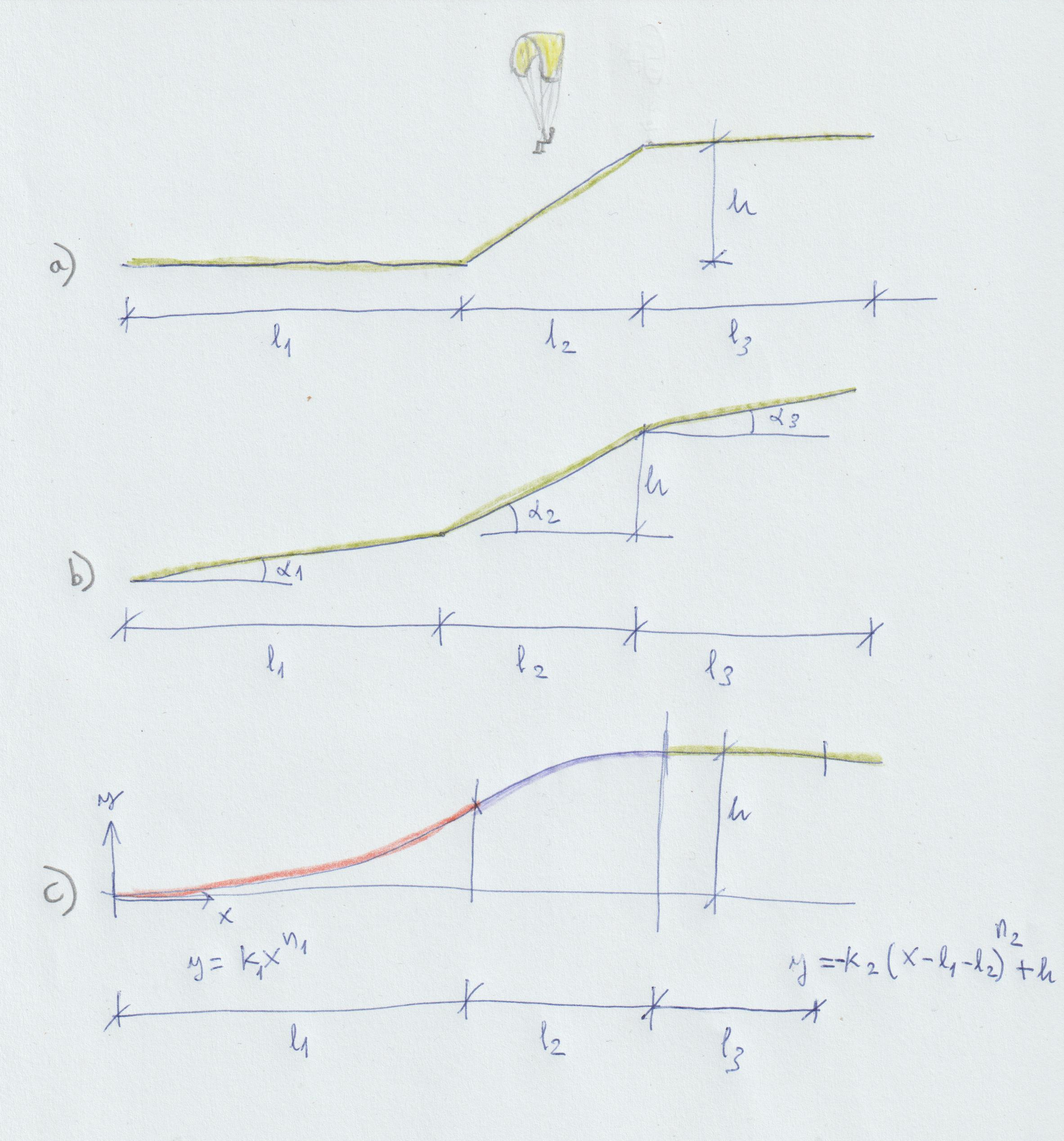
Figure 1. Some ramp sections
We can start by thinking about some logical sections for building ramps;
Figure 1a) An inclined plane of length l2 and height h, with horizontal terrain at the low point and high point of clear and obstacle-free lengths l1 and l2 respectively.
Figure 1b) Similar to the previous case but more generically with slightly inclined terrain with an angle alpha_1 in the landing zone and alpha_3 in the takeoff zone.
Figure 1c) We can project a smoother and more suitable section, using two generic parabolas of degree n. The right branch of a positive parabola, asymptotic to the landing terrain, and the left branch of a negative parabola. With the condition that the two branches coincide at a point on the ramp, with exactly the same slope (derivative). A bit complex to explain but intuitive to understand graphically.
We can define other sections, but with these we have a good starting point. We can also think about the development of the artificial hill. We can think of two main types. The first with a straight guideline. That is, forming the 3D surface by moving the section along a straight line, to form a hill in the shape of a ridge. The second type would be to create a surface of revolution, rotating the section around a vertical axis, to form a truncated cone or similar surface.
I would like to explain how to make the earth mountains, spread them in layers and compact them. Add topsoil and hydroseeds if necessary. Think about surface drainage. Make a list of measurements and calculate the cost of the project...
(2026-03-11 to be continued...)
And remember other Laboratori studies on this topic:

Beach dune

Inflatable and transportable dune